
Goals of English Education at Gunma University
At Gunma University, the following goals are set for English courses offered as part of the general education curriculum.
Common Goals:
1.Through participation in active and cooperative learning, become aware of one’s own relationship to society and culture, and develop the ability to express one’s identity through English in the most appropriate way while considering the setting and situation.
2.Through participation in active and cooperative learning, become aware of, deepen consideration of, and foster ability to discuss potential solutions to issues and changes in one’s surrounding environment.
First Year:
1. Through both speech and writing, develop appreciation of being able to communicate effectively their ideas about themselves, the society and culture in which they live, and other cultures.
2. Through reading and listening, develop understanding and appreciation of various cultures.
3. Develop sensitivity to, and appreciation of, their own and other varieties of English and the cultures they reflect.
4. Gain awareness of critical and rational thinking skills in English to consider issues in their own society and culture, and at an international and global level.
5. Through gaining an understanding of the role that they can play, develop an attitude of commitment to cooperating with others to solve problems.
Second Year:
1. Understand social diversity at the local, regional, and international levels, think critically and communicate effectively about issues in their own society and culture.
2. Develop the ability to discuss potential solutions to issues and changes at the local, regional, and international levels.
What Does English Proficiency Mean?
When we think of English proficiency, we often imagine skills such as reading, listening, writing, speaking, and interacting. However, simply understanding English is no longer sufficient to succeed today. We are required not only to recognize visible challenges, but also to identify issues that have yet to be noticed and to explore solutions to them.
Rather than merely accumulating knowledge, it is essential to connect with what we have learned and create new values. To achieve a sustainable society, we must collaborate with people from diverse backgrounds and address issues on a global scale. For this purpose, the ability to organize one’s thoughts and communicate them in one’s own words is indispensable. While maintaining one’s own identity, flexibility, empathy toward others’ perspectives, and strong communication skills are the keys to collaborating with the world.
Project-Based Learning (PBL)
The two-year English program is centered on Project-Based Learning (PBL), a form of active learning. The curriculum emphasizes problem- and task-solving approaches and incorporates many opportunities for students to learn collaboratively with others.
By “thinking and actually using” English both individually and in groups, students develop their English proficiency. Rather than focusing solely on the input of linguistic knowledge, the program emphasizes what students communicate in English and how they do so. Students also learn effective expression, methods of communication, and the processes involved in working as a team. The goal is to cultivate comprehensive English proficiency as a practical skill that goes beyond knowledge alone.
Active learning refers to a broad range of teaching and learning methods that encourage learners to actively participate in the learning process, fostering transferable skills such as critical thinking and collaboration.
General English Core Curriculum (GECC)
Developing English and Communication Skills through PBL
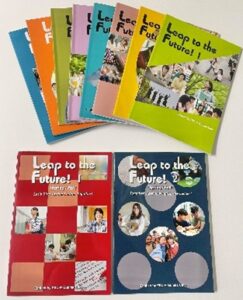
“Leap to the Future!”
Since the 2021 academic year, Gunma University has implemented English courses under a unified curriculum using textbooks developed in-house. A unified curriculum means that all classes use the same textbooks, syllabus, and assessment criteria.
From 2021 to 2023, classes were conducted using a textbook designed for first-year students. Beginning in 2024, the textbooks were revised, and English courses are now conducted using two textbooks: one for first-year students and one for second-year students.
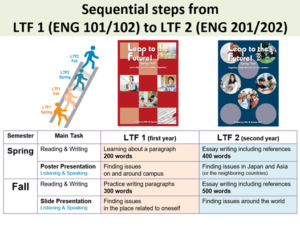
The textbooks consist of eight stages, with Stages 1–4 covered in the first semester and Stages 5–8 in the second semester. The curriculum begins with an introduction to the concept of PBL, followed by reading English passages written by Gunma University faculty members, writing English essays based on the readings, and delivering group presentations. Over the two-year English program, students work collaboratively on projects based on the following themes.
Project Themes
First Year, First Semester: What can be done to improve the university environment?
First Year, Second Semester: What issues exist in places familiar to you (your hometown or place of residence)?
Second Year, First Semester: What social issues become apparent when comparing Japan and Asia?
Second Year, Second Semester: Looking at the world, what can be done to make it a better place?
Poster Contest
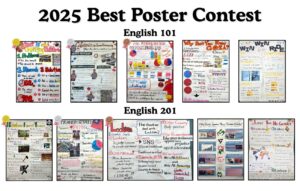
At the end of the first semester, each class selects its best poster and enters it in a poster contest held at the beginning of the second semester. The contest is conducted on the LMS, and both students and faculty/staff of Gunma University are eligible to vote.
Award-Winning Posters (AY 2025)
A System to Foster Independent English Learners
E-learning System: Reallyenglish
In Reallyenglish, an “Adaptive Focus” system automatically assigns lessons at an appropriate difficulty level based on each student’s English proficiency before lessons begin. Following a monthly learning schedule, students engage in grammar, reading, and listening lessons in a balanced manner.
In addition, students take a TOEIC practice test called TRACKER FOR THE TOEIC every two months to monitor their progress in English proficiency. Students’ engagement with the e-learning program is reflected in their course grades.
Portfolio
Students can review their learning records through their personal page on the academic affairs system. The following three components are available:
The Can-Do Statements can be completed a total of five times:
1. Upon entry in the first year
2. At the end of the first semester of the first year
3. At the end of the second semester of the first year
4. At the end of the first semester of the second year
5. At the end of the second semester of the second year
Results from external English proficiency tests include the placement test taken at the time of enrollment, as well as achievement tests administered at the end of the second semester in the first year and at the end of the second semester in the second year. In addition, by using the reflection function, students can record their learning each semester, making their learning progress over the two-year period visible and reviewable.
Let’s Leap to the Future Together!